The Smokehouse Master and the Eel
Robin followed Martin Hellström at the smokehouse in Nyehusen. About the wood, the eel hook and a craft that only comes with decades of experience.
Smoking eel is not something you rush. It's not just a matter of throwing it in and hoping for a good result. It requires commitment, patience and deep knowledge of the raw material — for it to turn out any good at all.
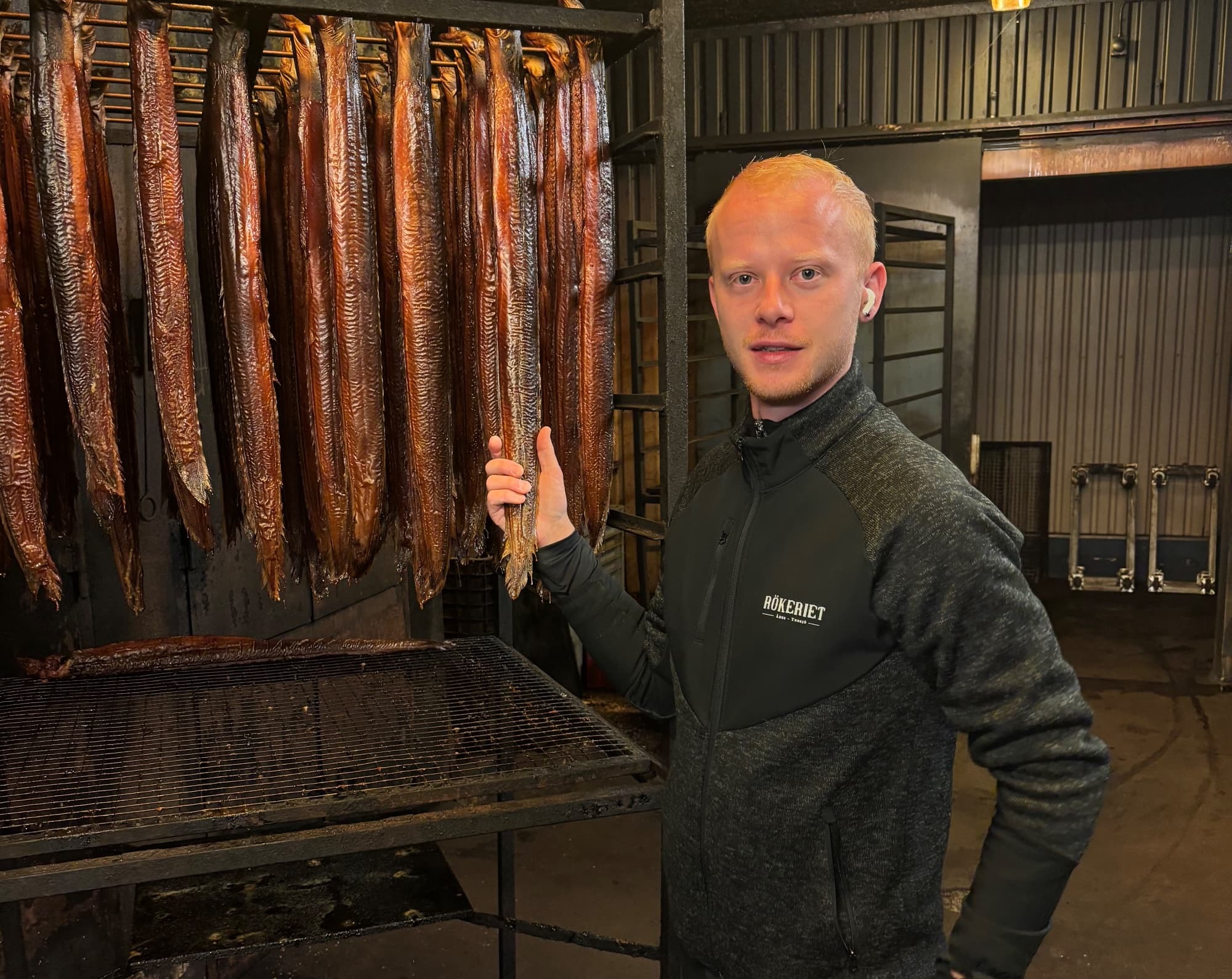
Over the past few days I've been following Martin Hellström at his smokehouse and experiencing the magic that happens over a few hours by the water's edge in Nyehusen. Rising early to light a fire with the wood stacked on the smokehouse floor, scalding and brushing each eel carefully — not too long, not too short, but just right — is a craft that only comes with decades of experience. Then those long, slippery creatures are hung in exactly the right spot, so they don't fall into the embers.
The pace is brisk, the grip on the eel's neck firm and steady. It looks simple — but it's an illusion. It's neither simple nor particularly steady when you're standing next to someone who is practically canonized in the village for his smoked products.
With a steady hand and clear voice, Martin announces that it's my turn to roll up my sleeves and get my fingers around the "eel hook". Kerstin shows with quick flicks the precision required to set the hook in exactly the right place. "A bit lower." "Hold a firmer grip." "A bit too long this time — shorter next." So I'm guided calmly and methodically through the small techniques that make the big difference.
The smoking itself is gentle and slow — it can't be rushed. Wood and chips are layered to maintain the right balance of embers, flames and smoke. The only measuring tool used is the smokehouse master's experienced thumb, which with a few careful pinches determines whether it should be warmer or cooler, more or less smoke, and how much time remains. There are no recipes, no fixed schedule. It takes as long as it takes — and when it's done, it's done. Everything affects the end result, even things you'd never normally think about. It's hard work — messy, wet and strongly scented — but there are no shortcuts to perfection.
I feel an enormous gratitude for having been allowed to step into Martin's smokehouse and gain an insight into a craft that carries generations of knowledge, tradition and fingertip sensitivity. It is an honour to carry this knowledge forward in my work and in our own smokehouse.
When you buy food craftsmanship, you don't just get a product — you get a story, a cultural heritage and a little piece of history in a bag.
/Robin